








A credit committee member can read a Credit Assessment Memo in one sitting. The analyst who prepared it however, may have spent the better part of a week getting it there. But if you take a close look, most of the week goes into the paperwork behind the memo, on KYC documents, GST returns, bank statements, income tax returns, audited financials, bureau reports and site visit notes.
Each arrives in its own format, different schedules and the numbers hardly ever agree with one another. Multiply that across a lender's pipeline, and it is easy to see why traditional MSME lending can take weeks or even months to move from application to approval and disbursement, according to a study by Omidyar Network and BCG. Banks' own published service standards reflect this: Indian Overseas Bank, for instance, allows up to 45 working days to decide on a fresh MSME loan or limit.
This gap is where most of the cost of credit assessment lives, and it is exactly where AI credit assessment memo tools are now being pitched. Some of that promise is real and some of it skips over the part of the job that should never be automated. This article looks at where the time actually goes in CAM preparation, what AI can reasonably take on, and what should stay with the analyst.
What goes into a Credit Assessment Memo, and why is it so slow to prepare?
A Credit Assessment Memo (CAM) brings a borrower’s financial, business, and credit information together into one structured assessment that supports the lending decision. Many Indian banks and NBFCs call it a Credit Appraisal Memorandum, but the job is the same. It is slow to prepare because the evidence behind it comes from many sources, and each one has to be gathered, checked and reconciled before a single paragraph of analysis can be written.
A typical CAM for an MSME or mid-corporate borrower covers the promoters and business background, the purpose of the facility, three years of financials and key ratios, cash flow and repayment capacity, banking conduct, collateral, group exposure, risks and mitigants, any deviations from credit policy, and finally the recommendation.
In a McKinsey podcast on banking operations (February 2026), McKinsey's Abhilash Sridharan noted that operations staff spend around 80% of their time on coordination and rule-based work, such as collating information and writing credit memos. In its report Seizing the agentic AI advantage, McKinsey describes a retail bank where relationship managers were spending weeks writing each credit-risk memo by hand, pulling from at least ten data sources.
That is the real problem. Proving every number in the memo takes time and hard work.
Where does the time actually go in manual CAM preparation?
Following a single application from upload to committee and the time splits into six stages:
Collecting and chasing documents
The application arrives incomplete. The balance sheet is a scanned PDF with a missing schedule, the bank statement covers eleven months instead of twelve, and the GST details haven’t come through. The analyst emails the relationship manager, who calls the borrower, who sends the file two days later.
Extracting and re-keying figures
Once the documents are in, someone types the numbers back into the bank’s spreading template: three years of profit and loss, balance sheet and notes, line by line.
Reconciling sources : This is the stage where time becomes hazy. Say the GST returns show INR 18 crore of turnover, bank credits suggest INR 14 crore, and the ITR shows something else again. A large receivable sit with a company that shares a director with the borrower, but it only shows up in the notes to accounts. Every gap has to be explained before the analysis can be trusted.
Analysing : This is where the analyst builds the case for or against the loan. Ratios, the working capital cycle and debt service coverage show whether the business can carry the debt, while repayment capacity, group exposure and industry outlook show whether it can keep doing so if conditions turn. Alongside the numbers, the analyst weighs the qualitative side, such as the promoters' track record and how the business has handled difficult periods before.
Writing : The analyst then turns the analysis into a narrative, writing the risk commentary, mitigants and recommendation into the bank's template, section by section. Every claim in the memo has to tie back to evidence elsewhere in the file, and any deviation from credit policy has to be named and justified. The memo also has to make a clear case without overstating the borrower's strengths or playing down its weaknesses.
Review loops : The reviewer sends the memo back for a missing stock statement or an unexplained jump in debtors, and part of the cycle starts again.
The first three stages consume the most time and involve the least judgement. They are also where errors creep in, because re-keying and cross-checking by hand is exactly the kind of work people get wrong when they are tired or rushed. The last three stages are where an experienced analyst earns their place.
How are banks using AI in credit assessment today?
Large lenders have moved from experimenting with AI to full-fledged rollouts. In August 2026, DBS announced that it had extended an agentic AI tool for corporate credit assessment to about 1,500 relationship managers and credit risk managers, after a pilot with 150 users.
Specialized agents work through more than 70 tasks to produce a review-grade first draft of the credit memo. DBS said credit memos and related work can take up to 40% of a relationship manager’s time, and it is targeting a reduction of at least 30%. That figure is a target, though. DBS hasn’t yet published outcomes from the rollout.
The design is telling: the AI drafts, and people decide. DBS says its bankers and credit risk managers remain responsible for refining the draft with client knowledge and industry judgement. S&P Global, launching its own credit memo tool in June 2026, describes it as keeping an analyst in the loop and states that it is not a substitute for independent credit analysis. The industry is not handing credit decisions to software. Rather, it is trying to give analysts back the time they spend on assembly.
What should an AI-powered CAM generator actually do?
If you are evaluating an AI CAM generator, the useful question is whether it takes over the right parts of the work, and whether you can check what it did. A capable tool should:
- Handle multiple documents at once: PDFs, scanned documents, spreadsheets, etc., and identify what each document contains, so analysts don’t have to sort everything manually.
- Pull out financial data and standardise it using the institution’s own chart of accounts, making it easier to compare different borrowers.
- Compare information across documents and flag anything that doesn’t match for example, turnover across GST filings, bank statements and financials; borrower details across KYC documents; or related-party transactions.
- Create a clear borrower summary covering the business, banking behaviour and financial performance, so an analyst can understand the borrower quickly.
- Draft the CAM section by section using the bank’s own format, instead of creating a generic report that someone has to rework on.
- Show the source for every number. Analysts should be able to see exactly which document and page a figure came from. Otherwise, they’ll have to manually verify everything again, which defeats the purpose of using AI.
- Work within the bank’s existing loan origination system and credit process, rather than becoming another separate tool where analysts have to upload and manage documents.
The last two points are especially important.
A tool may produce a great-looking memo, but if analysts can’t trace the numbers back to their sources or have to work outside their existing system, it can end up creating more work instead of saving time.
How can AI speed up CAM preparation without replacing credit judgement?
The most important distinction in AI-assisted credit work is between flagging a problem and resolving it.
AI can tell you that GST turnover and bank credits differ by INR 4Cr, but it might not be able to tell you why. The gap may be due to seasonal billing that settles next quarter or due to sales routed through a related entity’s account.
It might be the first sign of revenue being inflated for the loan. Only an analyst who talks to the borrower, knows the industry and reads the rest of the file can make that call, and that call is the whole point of credit assessment.
The parts of the job that should stay human are the ones that rely on context and accountability: conversations with the borrower and promoters, the assessment of management quality, how the industry is likely to move, how a facility should be structured, and the final recommendation itself. A credit committee should be able to see a named person behind every memo.
What to check in an AI-drafted CAM before signing it
- Every key figure traces back to its source document.
- Every flagged discrepancy has been investigated, and the explanation is written into the memo.
- A sample of ratios has been recomputed by hand and matches.
- The narrative says what the numbers say, with no confident commentary sitting on top of weak financials.
- Policy deviations are named and justified, not buried.
- The final recommendation is the analyst's own, in the analyst's words.
From borrower documents to a structured CAM: Where CredAble’s CAM Generator fits
CredAble’s AI-powerd CAM Generator is built around the stages where a manual CAM work slows down. Its workflows run from documents through AI extraction, financial analysis and a credit risk engine, and ends in a structured CAM.
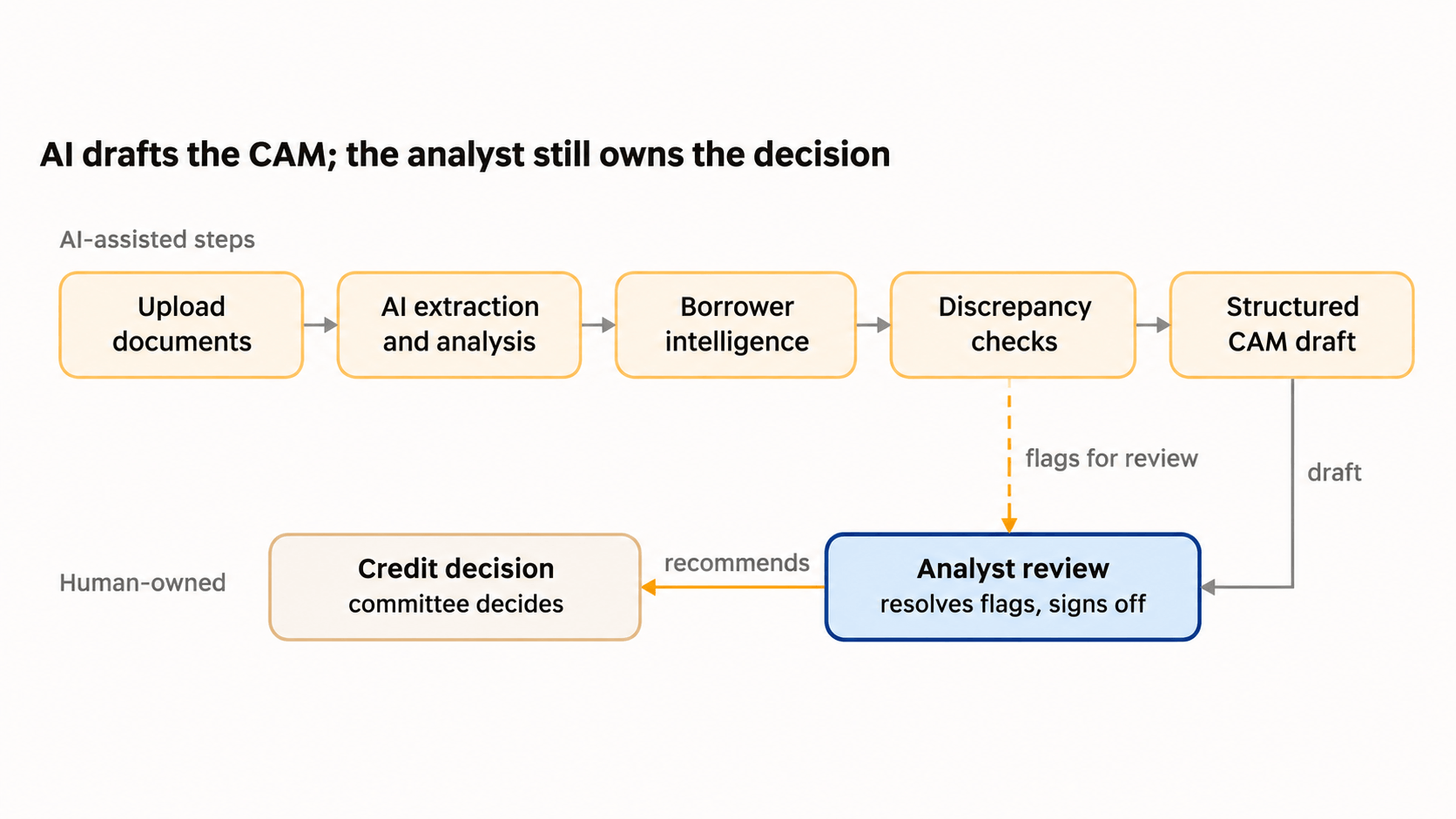
In practice, credit teams upload a loan application’s documents together rather than processing them one by one. The CAM Generator analyses information across those documents and flags discrepancies for review, which is the reconciliation work we spoke about earlier.
It produces automated borrower-level summaries and AI-led profile analysis, so the analyst starts from a consolidated picture instead of a folder of files.
Section-wise user prompting lets teams shape individual CAM sections to their requirements, and an AI credit assistant supports more detailed evaluation of specific questions.
It can also integrate with existing lending, credit and underwriting systems, so the CAM sits inside the workflow that the bank already runs.
The goal is to keep analysts in the loop by highlighting flags that require investigation, drafts that need reading, and recommendations that require a final human sign-off.
The case for AI in credit assessment is usually made in hours saved. The stronger case is about what those hours are spent on. When the legwork is done up front, analysts can give their attention to the judgement calls that decide whether a loan is sound, and the memo that reaches the committee carries its evidence with it.
Borrowers get an answer sooner as a result, without the lender relaxing its standards to get there. A CAM will always take judgement to finish. It no longer must take days to start.
See how CredAble’s CAM Generator handles a sample loan application. Book a demo.
Think Working Capital… Think CredAble!