







Why Banks Are Banking Big on Agentic AI: The New Brain Behind Lending
As global trade dynamics shift and liquidity cycles compress, global banks and financial institutions now stand at the intersection of two defining forces: financial technology innovation and artificial intelligence. Together, these forces are fundamentally changing how capital is delivered, managed, and optimised.
Today a fully digital SME lender can achieve instant decisions and same‑day funding, delivering funds within 24 hours with a 15‑minute application process. Is this shift the new reality?
At the centre of this shift lies a fundamental question: How can banks remain competitive in this AI driven real-time economy?
The Pressure Is Mounting on All Fronts
Banks today are navigating tighter regulatory scrutiny, rising cost of capital with some operating over 75000 siloed databases, which makes real-time insight extraction both slow and error-prone. Traditional loan origination systems, often built on hard-coded rules and legacy infrastructure, further compound this problem.
Artificial intelligence, and specifically agentic AI, now offers a way forward.
The Market Opportunity Is Urgent and Unmissable
Working capital is the financial engine that keeps global supply chains moving, enabling businesses to pay suppliers, manage inventory, and meet short-term financial obligations. The Global working capital financing represents a multi-trillion-dollar addressable market. Additionally with this Citi bank quotes, artificial intelligence could add $170 billion to global banking profits by 2028, lifting profits from $1.8 trillion to nearly $2 trillion.

AI and agentic AI together could unlock $200 billion to $340 billion in annual value across banking. Of this, agentic AI infrastructure alone is expected to drive an $80 billion opportunity, growing at a compound annual rate of 43%.

Agentic AI: From Automation to Autonomous Intelligence
Agentic AI has evolved beyond rule-based automation into self-directed, intelligent systems that continuously learn and adapt. In the context of lending, it is transforming rigid, linear workflows into adaptive, real-time journeys.
These AI systems have evolved over time to ingest and process live borrower data, macroeconomic trends, and behavioural signals to enable faster underwriting, dynamic pricing, and personalised loan structures. Alongside being technical this shift is getting more strategic.

How does AI solve for core Pain points?
Data-Intensive Pipelines: Underwriters are burdened with PDFs, invoices, and images, often resulting in delayed approvals. McKinsey finds that banks that adopt digital lending platforms can reduce loan processing times by up to 70%.
Additionally, companies that adopt AI-powered invoice processing report 30 to 50 percent cost savings over a 3 to 5 year period.
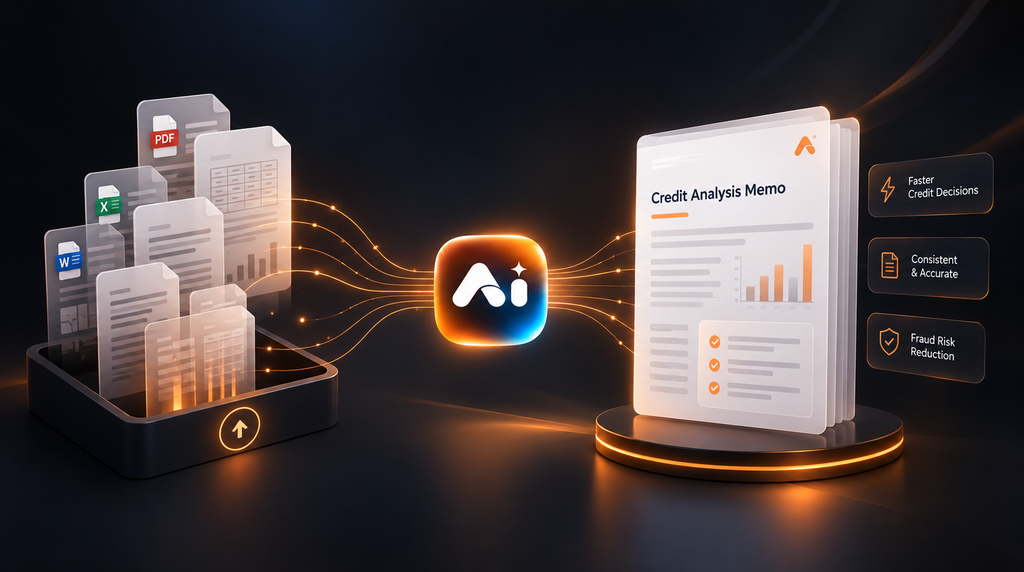
AI leverages optical character recognition (OCR) and natural language processing (NLP) to auto-extract and structure data from multiple formats, drastically accelerating loan decisions.
Legacy Technology Debt: Traditional LOS platforms are often slow to update, requiring weeks for minor configuration changes. AI introduces modular, API-first systems that do 25x faster loan processing, and enables 80%+ more accurate fraud identification and credit risk assessment.
Rising Operational Costs and Experience Gaps: Legacy systems and batch processing create inefficiencies and customer dissatisfaction. Conversational AI improves borrower experience with real-time updates, guidance, and tailored loan options. Simultaneously, bots manage repetitive tasks round-the-clock, delivering consistent SLAs while reducing operating costs by 20–70%.
AI Across the Lending Lifecycle
AI doesn’t just support underwriting; it builds interoperability and synergy within the entire loan journey:
The below image outlines a structured approach to embedding AI agents across the end-to-end customer journey. It begins by mapping key customer interactions, then breaking them down into specific processes and underlying workflows.
Each workflow is composed of granular tasks where AI agents can be deployed to automate operations at scale. It emphasises that the largest opportunity for AI agents lies in automating interconnected workflows not just isolated tasks. The greatest opportunity lies in embedding AI where tasks are repetitive, data-rich, and decision-critical.

A Banker’s View: Lending Through the Balance Sheet Lens
In 2025, banks are looking at agentic AI not only as a technology solution, but as a tool for balance sheet transformation. Key shifts bankers are witnessing:
- From Underwriting to Understanding
Legacy underwriting relied on static financials and bureau scores. Agentic AI enables contextual lending using real-time behavioural insights, supply chain data, and ecosystem signals.
- From Human Bottlenecks to Intelligent Throughput
AI automates screening, document validation, fraud detection, and more. According to EY, banks report reduction in processing time and higher first-pass approval accuracy.
- From Cost Optimisation to Revenue Generation
Pre-approved offers, dynamic pricing, and embedded credit journeys are unlocking new lending opportunities. AI is enabling contextual cross-sell and reducing borrower drop-offs.
- From Legacy Overhaul to Cognitive Layering
Rather than replacing LOS, agentic AI integrates as a cognitive layer, learning from workflows and making intelligent decisions without disrupting existing architecture.
PwC 2025 survey found that 79% of organizations across industries, including banking, have adopted AI agents to some extent, with 19% deploying at scale and 35% running pilots
Major institutions such as Wells Fargo, HDFC Bank, and State Bank of India are actively investing in agentic AI to streamline workflows, reduce operating costs, and enhance lending agility.
Strategic Risk: The Explainability (AIX) Barrier
Despite its promise, agentic AI presents challenges around transparency. Many advanced models operate as "black boxes," making it difficult for credit teams to explain the basis of decisions. In regulated markets, this is more than a concern—it is a barrier to adoption.
As a result, the use of Explainable AI (XAI) techniques such as SHAP and LIME is growing. These methods allow institutions to deconstruct AI decisions into interpretable factors that can be reviewed, audited, and defended.
CredAble’s Trained Agentic AI Stack
At CredAble, we have developed a purpose-built agentic AI layer for banks and financial institutions. Seamlessly integrating with your existing LOS, enabling:
- Predictive prospecting based on borrower behaviour
- Self-learning underwriting workflows
- Real-time decision-making and risk scoring
- Intelligent compliance checks and alerts
In a financial landscape where precision and speed define competitiveness, adopting agentic AI is no longer optional. It is essential.
To explore how CredAble AI can power your lending transformation, connect with us.
Think Working Capital… Think CredAble!