The Hidden Cost of Equity: Why Startups Are Reclaiming Ownership Through Smarter Debt Financing

In April 2025, India’s startup funding ecosystem recorded just $745 million in capital inflows—the lowest monthly tally in over four years. While 2024 did bring signs of recovery, with total funding rising to $12 billion (a 20% increase over 2023), the shadow of 2021’s $42 billion peak still looms large. But the real story isn’t about the decline in funding—it’s about what founders are doing in response.

Across the board, we’re seeing a new mindset: capital ownership over capital chase. In boardrooms and co-founder chats, a quiet revolution is unfolding—where valuation is no longer the end goal and dilution is no longer a necessary evil. Founders are increasingly opting for smarter, non-dilutive debt to fund growth. Not because they can’t raise equity, but because they choose not to—especially when the price of equity is autonomy.
Explore CredAble’s Startup Financing SolutionsEquity’s Hidden Cost is Now Out in the Open
As Indian startups scale, many are coming to a difficult realization: each equity round not only brings capital but often takes away alignment. Nearly 40% of startup founders at the pre-IPO stage now prefer debt financing, not just to preserve ownership, but to protect decision-making freedom.
This trend is especially evident in D2C and SaaS businesses, where growth is operationally intensive and requires predictable working capital—not strategic dilution. As Fortune India noted, funding for India’s D2C segment declined 18% in 2024, but the ecosystem remains the second largest globally. What’s changing isn’t ambition—it’s how that ambition is financed.
Equity capital has become more selective and concentrated in later-stage bets. The bar for early- and mid-stage startups is now steeper—forcing founders to assess not just whether they can raise equity, but whether they should.
Startups Are Rethinking the Financing Playbook
In this evolving narrative, debt is no longer a compromise—it’s a capability.
Modern-day founders are treating capital as a resource that must match the rhythm of their business. And debt, when structured well, is proving to be the more sustainable, scalable option. It doesn’t dilute ownership. It doesn’t come with quarterly boardroom fire drills. And it doesn’t shift focus from product to pitch decks.
From inventory-led D2C brands to cashflow-rich SaaS platforms, founders are blending revenue-linked debt, vendor financing, and short-tenure credit lines into their capital stack. This approach brings two advantages:
- Operational freedom, without premature governance pressure
- Faster capital cycles, better suited for funding growth loops like customer acquisition, supply chain expansion, and receivables management
A growing cohort of lenders—including fintech-enabled NBFCs—are stepping in with capital that’s fast, flexible, and founder-first.
CredAble’s View: Designing Capital That Doesn’t Cost Control
At CredAble, we’ve always believed that liquidity shouldn't come at the cost of equity.
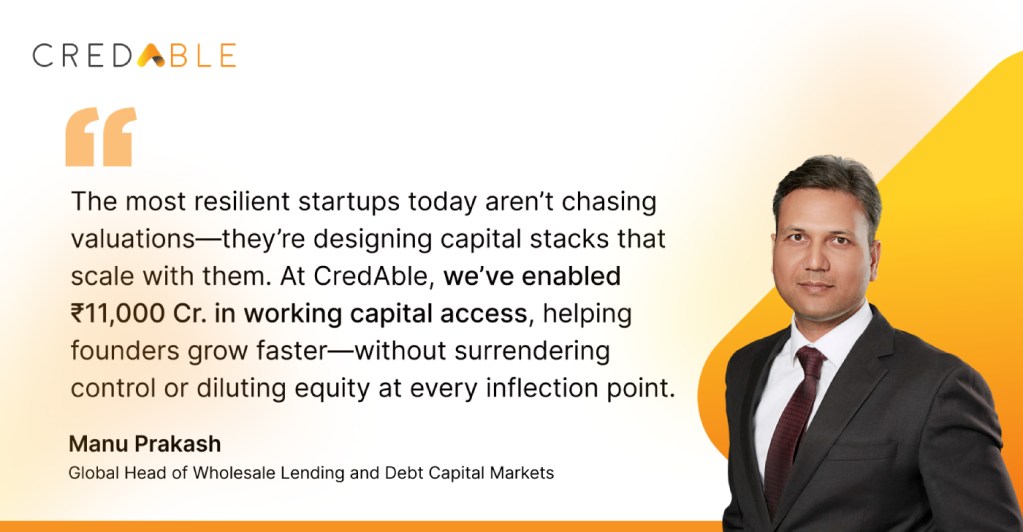
Over the last year, we’ve partnered with some of India’s leading startups and unicorns, co-creating growth-linked working capital programs that unlock liquidity without dilution. Our working capital solutions have powered over ₹11,000 Cr. in financing, enabling our startup partners to achieve 2x growth post-funding—not by raising more equity, but by using capital more intelligently.
From revolving short-term credit lines to supply chain and vendor financing, our credit structures are designed to flex with scale, not stifle it.
The goal is simple: to help founders scale without selling out. And in doing so, we’re redefining what modern-day working capital looks like—for India’s next wave of growth businesses.
Partner with CredAblePolicy Backing is Accelerating the Shift
This structural shift in startup financing isn’t being driven by founders alone—India’s policy machinery is leaning in to support it.
- The Credit Guarantee Fund Trust for Micro and Small Enterprises (CGTMSE) has expanded coverage and simplified eligibility to bring early-stage enterprises into the formal credit fold. This gives founders access to institutional debt without heavy collateral requirements.
- The Credit Guarantee Scheme for Startups (CGSS), backed by NCGTC, is now providing credit guarantees on loans up to ₹10 Cr., giving lenders confidence to underwrite newer ventures with innovative business models.
- Most notably, NITI Aayog has officially proposed embedding cashflow-based financing into India’s MSME policy framework. The aim? To formalize alternative financing routes like revenue-based financing (RBF) and working capital credit lines, especially for digital and tech-first enterprise.
This coordinated push from government institutions is transforming non-dilutive capital from an alternative into a nationally backed growth engine. For founders, this means more structured, lower-risk, and regulatorily aligned access to credit that doesn’t cost equity.
From Capital Takers to Capital Architects
The startup landscape is maturing. So is its approach to capital.
Today’s founders aren’t just building companies—they’re architecting capital stacks that align with their long-term vision. And increasingly, that means keeping equity sacred and using debt strategically.
We’re entering an era where startup success isn’t defined by the size of the cap table, but by how well it’s been protected.
Where capital isn’t just raised—it’s designed.
Where founders don’t just build for scale—they finance it on their terms.
In this context, smart debt isn’t a fallback. It’s freedom.
Think Working Capital… Think CredAble!