







The AI-First NBFC: From Credit Underwriting Automation to Autonomous Lending

An NBFC can reduce a loan approval from two days to twenty minutes and still make the wrong credit decision.
The latest data shows how easily that happens. India’s commercial credit book looked calm in March 2026, with delinquencies broadly stable at 1.8%. Yet beneath that headline, unsecured business loans originated in March 2025 showed early delinquencies 2.9 times higher than the overall book, according to the July 2026 MSME Pulse report from SIDBI and TransUnion CIBIL.
Lenders are not slowing down. Credit from major NBFCs and housing finance companies grew 14.4% year on year in June 2026, up from 11.1% a year earlier, and retail loans grew faster still, at 20.3%.
Speed matters, particularly to a small business waiting for working capital or a business loan. But speed alone says little about the quality of the decision, the cost of reaching it or the lender’s ability to detect financial stress six months later.
That is the question Kapil Kapoor believes the industry must address as it moves towards autonomous lending: not how fast a lender can decide, but how well.
At the recent ETBFSI NBFC Leaders’ Retreat, industry leaders said NBFCs could automate 50–80% of business processes over the next few years. The debate is no longer about speed. It is about the quality of the decisions that speed produces.
An NBFC can cut a loan approval from two days to twenty minutes and still make the wrong credit decision. Three numbers show how:
- ₹65.8 lakh crore of commercial credit is outstanding, with delinquencies stable at 1.8%.
- Yet unsecured business loans originated in March 2025 show early delinquencies 2.9 times higher than the overall book.
- Meanwhile, NBFC credit grew 14.4% year on year in June 2026.
On the retreat’s panel, Kapil Kapoor, CTO & CPO at CredAble, put it this way:
The sections below follow that logic: before the decision, at the decision and after it.

How AI Is Changing Credit Underwriting and Lending Decisions
Traditional credit underwriting requires teams to gather, verify and interpret information from multiple sources. Financial statements, banking transactions, GST records, bureau reports and invoices may each tell part of a borrower’s story.
The scale of the opportunity makes the case for change. Only 41% of India’s registered MSMEs have accessed formal credit, and the share of new-to-credit enterprises in commercial originations fell from 52% in FY2023 to 42% in FY2026. Reaching the rest will take more than adding underwriters.
Better data is arriving to support that effort. In FY26, loans enabled by the Account Aggregator framework accounted for 8.4% of India’s retail and MSME lending by value and 11.8% by volume, worth ₹3.82 lakh crore, according to Sahamati.
AI-powered credit underwriting can bring these inputs together, identify inconsistencies and help credit officers focus on the information that matters.
Consider a borrower whose reported revenue is growing while banking inflows are declining. Or a business whose overall sales remain stable even as its dependence on a single customer increases.
These are signals that may not be immediately visible when credit assessments rely on fragmented information and manual reviews.
AI can help surface them earlier. However, identifying a risk is different from deciding how to act on it.
That distinction becomes important when considering how much decision-making authority a financial institution should delegate to technology.
Early results from large lenders suggest the productivity gains are real. Tata Capital reported that AI-driven credit assessments now assist underwriting for 80% of its SME portfolio, and said its Underwriting Assist platform has reduced credit memo preparation time in SME underwriting by 30%.
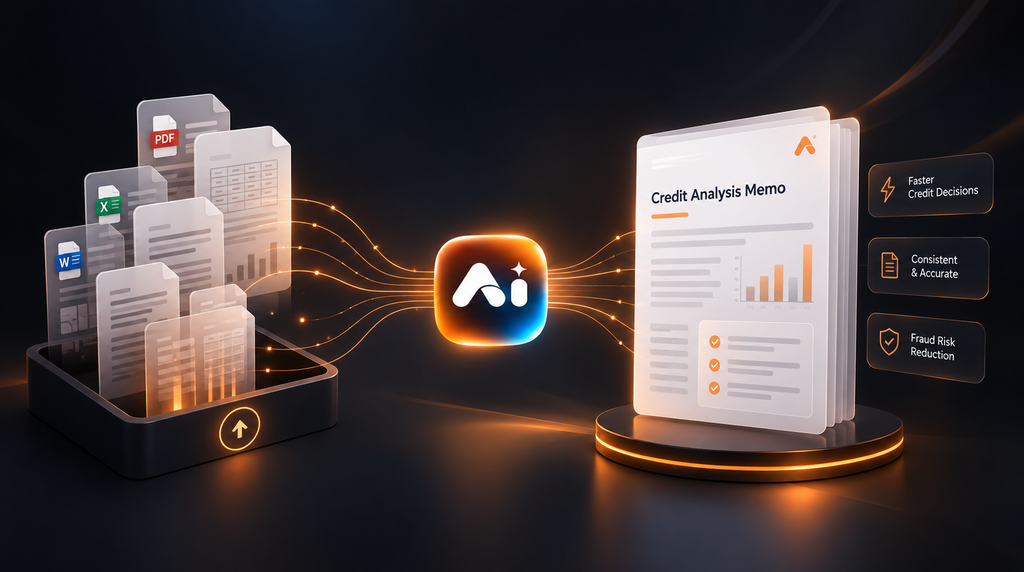
CredAble’s AI CAM Generator does this in practice. It ingests a borrower’s documents, extracts the data, runs the financial analysis and credit risk checks, and drafts a structured Credit Assessment Memo in minutes rather than days. Along the way it cross-checks information across documents and flags discrepancies for review, so credit officers spend their time on the questions the memo raises, not on assembling it.
From Lending Automation to Bounded Autonomy
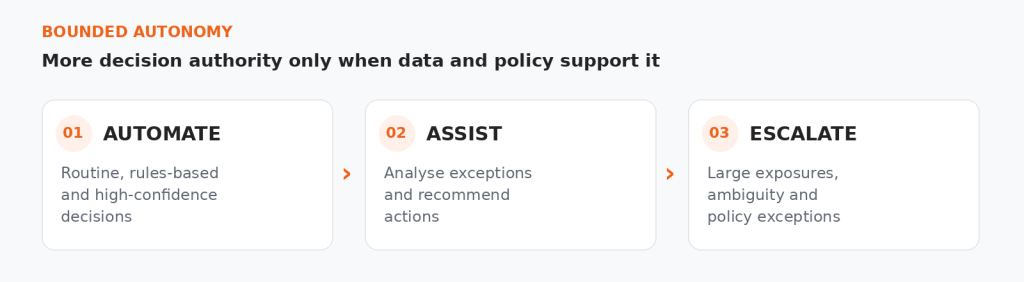
Automation works well when the task and its rules are known. Extract figures from financial statements, check document completeness or route an application to the appropriate team.
AI-assisted systems can go further. They can compare information across sources, flag contradictions and recommend actions.
Autonomous lending takes another step by allowing systems to initiate or execute certain decisions within permissions and risk limits established by the institution.
Few institutions are there yet. RBI’s survey for its FREE-AI report found that only 20.8% of surveyed entities were deploying AI systems at all, while Gartner expects 15% of day-to-day work decisions to be made autonomously through agentic AI by 2028, up from none in 2024. Autonomy will arrive unevenly, which makes the question of where to allow it more important than how quickly.
A standardised ₹2 lakh facility supported by reliable information is very different from a ₹50 crore structured working-capital exposure involving multiple counterparties and negotiated terms.
The first may justify largely automated decisions. The second demands experienced credit judgement.
A system should receive greater decision-making authority where the data is dependable, the credit policy is clear and the consequences are limited. Human intervention becomes more important as exposure, complexity or uncertainty increases.
A high-confidence loan renewal, for example, may proceed automatically when repayment performance and exposure remain within policy. A borrower showing new concentration risks should receive closer scrutiny, even if the headline eligibility score remains unchanged.
The difficult work is defining these boundaries well enough for credit teams, risk functions and management to trust them.

Why AI in Lending Must Go Beyond Loan Approval
Much of the conversation around AI in lending focuses on reducing underwriting turnaround times.
That is understandable. The inefficiencies are visible, and the benefits of faster processing are relatively easy to measure.
The risk, however, often surfaces after approval. The MSME Pulse report found stress concentrated in pockets even as the overall portfolio held steady: early delinquencies in the ₹2–10 lakh enterprise exposure segment were 2.1 times higher. A portfolio average can look healthy while specific cohorts deteriorate.
Consider a hypothetical NBFC managing a portfolio of 10,000 borrowers.
Reviewing every account at the same frequency and depth is expensive. The more useful question is which 100 accounts have materially changed this week, what those changes indicate and whether they justify intervention.
AI-powered credit risk management can help institutions move from periodic reviews towards continuous monitoring based on borrower behaviour, repayment patterns, banking activity and emerging concentration risks.
The first disclosures are encouraging. Tata Capital said its AI-based portfolio monitoring platform helped reduce its credit cost by about 14 basis points in FY26.
Collections provide another example.
Two borrowers may both be seven days overdue. One is facing a temporary cash-flow mismatch. The other is experiencing declining business activity and delaying payments across suppliers.
A standard automated reminder workflow treats them alike.
A more intelligent system can recognise their different circumstances and help teams determine an appropriate response.
In many portfolios, identifying deterioration early could create more value than reducing loan approval time by another few minutes.
Making AI-Powered Lending Commercially Viable
At the panel, Kapoor argued that AI adoption must be evaluated against the method it replaces.
A system that produces a convincing credit memo is a useful demonstration. It is not, by itself, proof of commercial value.
Industry analysts share the caution. Gartner predicts that more than 40% of agentic AI projects will be cancelled by the end of 2027 because of escalating costs, unclear business value or inadequate risk controls.
Financial institutions need to ask harder questions.
Did AI improve the accuracy of credit assessments? How frequently did analysts need to correct its recommendations? What did the institution spend preparing data, integrating systems, validating outputs and managing exceptions?
A less expensive model may ultimately cost more if employees repeatedly verify or redo its work. Equally, the most sophisticated AI model is unnecessary for every routine task.
The objective should be to use the capability the problem requires and measure the complete cost of producing a reliable outcome.
The lenders that report results tend to measure outcomes of this kind. Tata Capital credits its AI-led initiatives with helping lower its cost-to-income ratio by about 335 basis points in FY26, while Bajaj Finance’s managing director said on the Q3 FY26 earnings call that disbursements through AI-powered call centres stood at about ₹1,600 crore.
Making that knowledge usable by AI and connecting it to live loan origination systems and credit workflows may prove more valuable than access to any particular foundation model.
People Also Ask -
AI helps lenders analyse financial statements, banking transactions, credit bureau information and other borrower data to identify inconsistencies, assess risks and support credit decisions. It can automate routine assessments while enabling underwriters to focus on complex cases requiring human judgement.
Lending automation performs predefined tasks such as document processing, verification and application routing. Autonomous lending goes further by enabling systems to initiate or execute certain decisions within established credit policies, permissions and risk thresholds.
AI can assist with routine credit assessments, data analysis and decision recommendations. However, complex exposures, uncertain borrower situations and policy exceptions continue to require experienced credit judgement, human oversight and clear accountability.
NBFCs can use AI to analyse repayment behaviour, transaction patterns, financial information and emerging borrower risks throughout the loan lifecycle. This enables more targeted portfolio monitoring, earlier identification of financial stress and better-informed interventions.
RBI’s survey for its FREE-AI report found that 20.8% of surveyed entities were deploying AI systems, mainly in customer support, sales, credit underwriting and cybersecurity. Larger lenders are reporting measurable results: Tata Capital, for example, says AI-driven credit assessments now assist underwriting for 80% of its SME portfolio.
Think Working Capital… Think CredAble!