How MSMEs Can Unlock $19Mn in Working Capital and Improve Cash Flow

In 2025, working capital moved from the back office to the boardroom.
Companies were profitable on paper, but cash was moving slower in reality. Since 2019, global net working capital cycles have lengthened by over 9 days on average, locking more cash into receivables and inventory despite stable earnings.
In parallel, payment delays have become a growing liquidity drag globally, with businesses facing an average ~62 days to receive payments, while MSMEs in India wait nearly ~195 days beyond agreed terms - one of the longest delayed payment cycles among major economies.
Growth is no longer constrained by markets. It is constrained by how efficiently cash moves through the business.
57% of growth corporates in the U.S. and Canada now use working capital gains to pay suppliers faster. Beyond that, deployment priorities diverge. U.S. firms reinvest primarily into product innovation (62%), while Canadian firms channel savings into sales and marketing. Working capital is now getting strategic.
With $2.15 trillion still locked in excess working capital globally, the focus heading into 2026 is not preservation. It is deliberate release and redeployment.
How are Corporates Using Working Capital Today
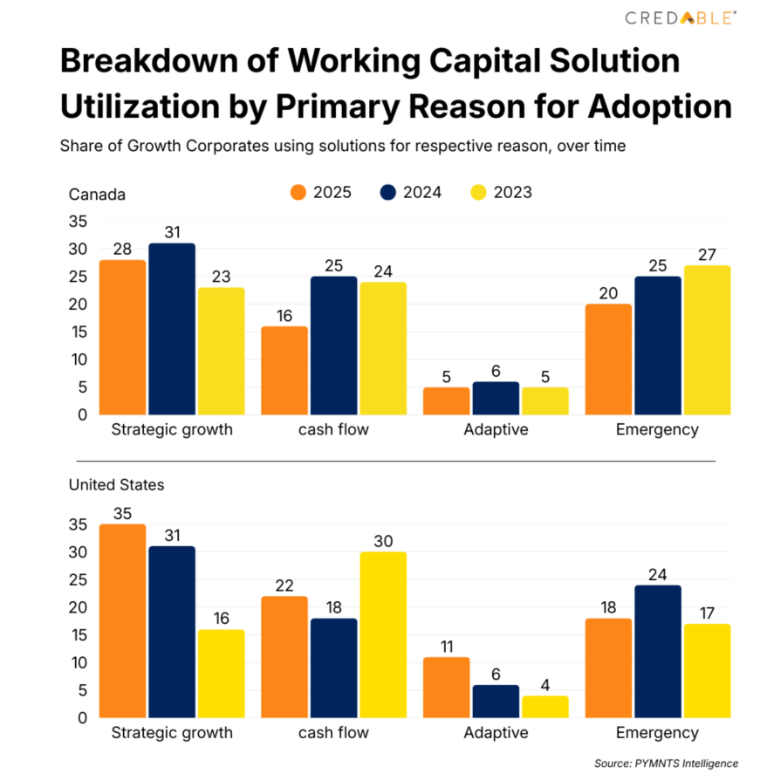
The shift from reactive liquidity management to deliberate capital deployment is no longer anecdotal. This shift is reflected in how corporates are adopting working capital solutions and the specific purposes these solutions now serve.
What began as emergency liquidity support is now increasingly driven by strategic growth and cash flow optimisation, particularly in the U.S. and Canada. Working capital is being used to fund product innovation, strengthen supplier relationships, and support go-to-market expansion rather than simply manage short-term stress.
Why Liquidity Pressure Became Structural in 2025
The data from 2025 points to something deeper. Cash conversion cycles (CCC) lengthened across regions and sectors. Liquidity slowed down and became trapped inside receivables, inventory, and misaligned payment terms.
Key indicators underline this shift:
- Net working capital days in the UK increased nearly 50% since 2015
- Days Sales Outstanding rose 5.7% over the past decade
- Days Inventory Outstanding increased 13.6% in cash-intensive Western sectors
These can't just be short-term anomalies. There stands a need for a system where operating models evolved faster than the financial infrastructure supporting them.
The result was predictable. Liquidity became harder to access precisely when flexibility mattered most.
Turn Liquidity into Strategic AdvantageHow Risk Buffering Quietly Locked Up Balance-Sheet Cash
Inventory decisions in 2025 were shaped by uncertainty. Businesses increased buffers to protect operations. Operationally, this made sense. Financially, it carried consequences.
Days Inventory Outstanding rose 13.6% in the most cash-intensive sectors across Western markets. Average DIO reached 90.2 days in the EU, 68.6 days in North America, and 62.8 days in the UK.
The result was a quiet erosion of liquidity. Cash became embedded in stock. Cash conversion cycles stretched further. Many organisations discovered that while supply chains were resilient, balance sheets were less flexible.
The insight from 2025 is clear.
Resilience without working capital discipline creates a different kind of risk.
Working Capital Became a CFO’s Tool for Speed, Not Survival
Not all organisations responded defensively.
Growth-oriented companies increasingly used external working capital solutions to act, not to wait. CFOs and Treasurers were 64% more likely in 2025 than in 2023 to deploy these tools for unplanned growth.
What stands out is intent.
- 27.0% used them for planned strategic investments
- 8.2% used them opportunistically to capture unexpected growth
In these cases, working capital stopped being a safety net. It became an execution tool.

What Leading CFOs Did Differently to Unlock $19 Million Without Raising Capital
Even in a challenging environment, some finance teams unlocked meaningful value.
Mid-market companies that approached working capital structurally freed up an average of $19 million. Not through cost-cutting, but through coordination across receivables, inventory, and payables.
The capital released was not left idle.
Liquidity created internally is often faster, cheaper, and more sustainable than capital raised externally.
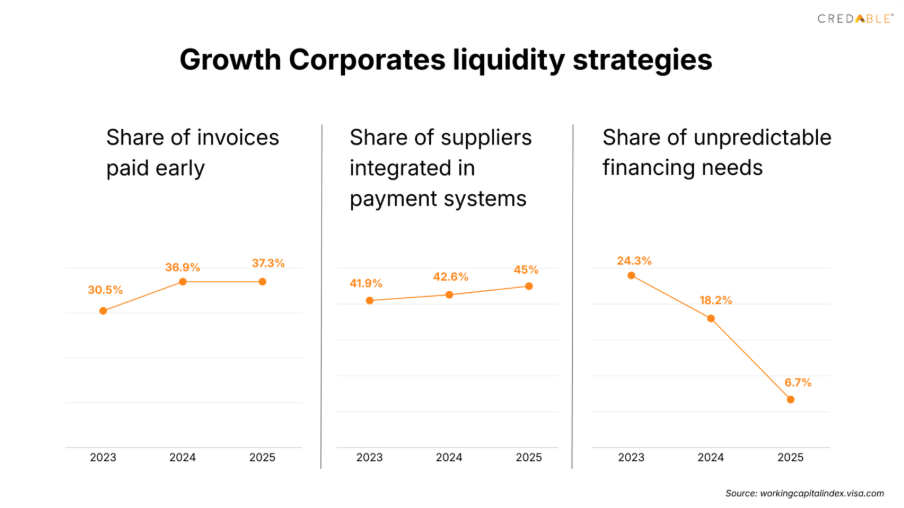
What 2026 Will Reward: Cash Velocity, Visibility, and Control
If 2025 exposed inefficiency, 2026 will reward execution.
Liquidity will be treated as a strategic resource. Finance teams will focus less on raising capital and more on improving cash velocity. Visibility across receivables, inventory, and payables will become non-negotiable.
Most importantly, execution will matter more than intent.
Where Digital-First Working Capital Infrastructure Fits
The data from 2025 points to a clear conclusion.
The organisations that outperform in 2026 will be those that align liquidity directly to real transaction flows.
This is where platforms like CredAble fit. Not as an overlay, but as infrastructure. Enabling access to working capital based on actual transactions and embedding financing into day-to-day operations.
In an environment defined by rising DSO, elevated inventory, and trapped cash, working capital is no longer a constraint by default. Managed well, it becomes a controllable asset.
Transform Working Capital Into AdvantageFrequently Asked Questions
In 2025, mid-market businesses faced structural liquidity pressure, driven by:
- Longer Days Sales Outstanding (DSO), delaying cash inflows
- Higher Days Inventory Outstanding (DIO), tying up cash in stock
- Slower cash conversion cycles across receivables, payables, and inventory
- Growing reliance on short-term funding due to trapped liquidity
These challenges revealed that working capital inefficiencies had been building over a decade, rather than being temporary disruptions.
Companies can turn trapped cash into growth capital by:
- Optimizing receivables to accelerate collections
- Improving inventory turnover without overstocking
- Aligning payables with supplier value creation
- Leveraging external working capital solutions for strategic payments
- Using digital platforms for real-time cash-flow visibility and execution
To reduce DSO and improve liquidity, companies can:
- Implement automated invoicing and payment reminders
- Offer early-payment incentives to customers
- Strengthen credit risk management and collection processes
- Monitor receivables in real time to prevent delays
- Align sales and finance teams for faster revenue-to-cash conversion
Growth Corporates use external solutions to:
- Accelerate payments to strategic suppliers
- Access short-term liquidity for unplanned growth opportunities
- Optimize inventory purchases to reduce cash lock-up
- Turn working capital into a competitive advantage rather than just a defensive tool
In 2025, 27% of firms used these solutions for strategic investments, and 8.2% for opportunistic growth.
Inventory optimization helps businesses:
- Free up cash trapped in excess stock
- Reduce holding and storage costs
- Improve cash conversion cycles
- Balance operational resilience with liquidity needs
High inventory buffers can protect operations but may create hidden liquidity risk if not managed strategically.
Digital platforms enable businesses to:
- Monitor cash flows in real time
- Align funding with actual transactions
- Automate approvals and reduce manual delays
- Integrate working capital solutions into daily operations
- Respond quickly to market volatility while preserving liquidity
Working capital is now treated as a growth enabler because it allows businesses to:
- Reinvest freed-up cash into innovation, supplier networks, and sustainable growth
- Strengthen operational flexibility
- Act proactively in volatile markets
- Improve financial decision-making speed and agility
Best practices include:
- Synchronizing supplier payment terms with cash inflows
- Accelerating strategic supplier payments to secure better terms
- Negotiating flexible buyer payment schedules
- Using data-driven forecasting to prevent liquidity gaps
- Leveraging technology to monitor and control cash flows efficiently
Think Working Capital… Think CredAble!